
One hundred distortions on one knob, and every position between them
WHAT IT DOES
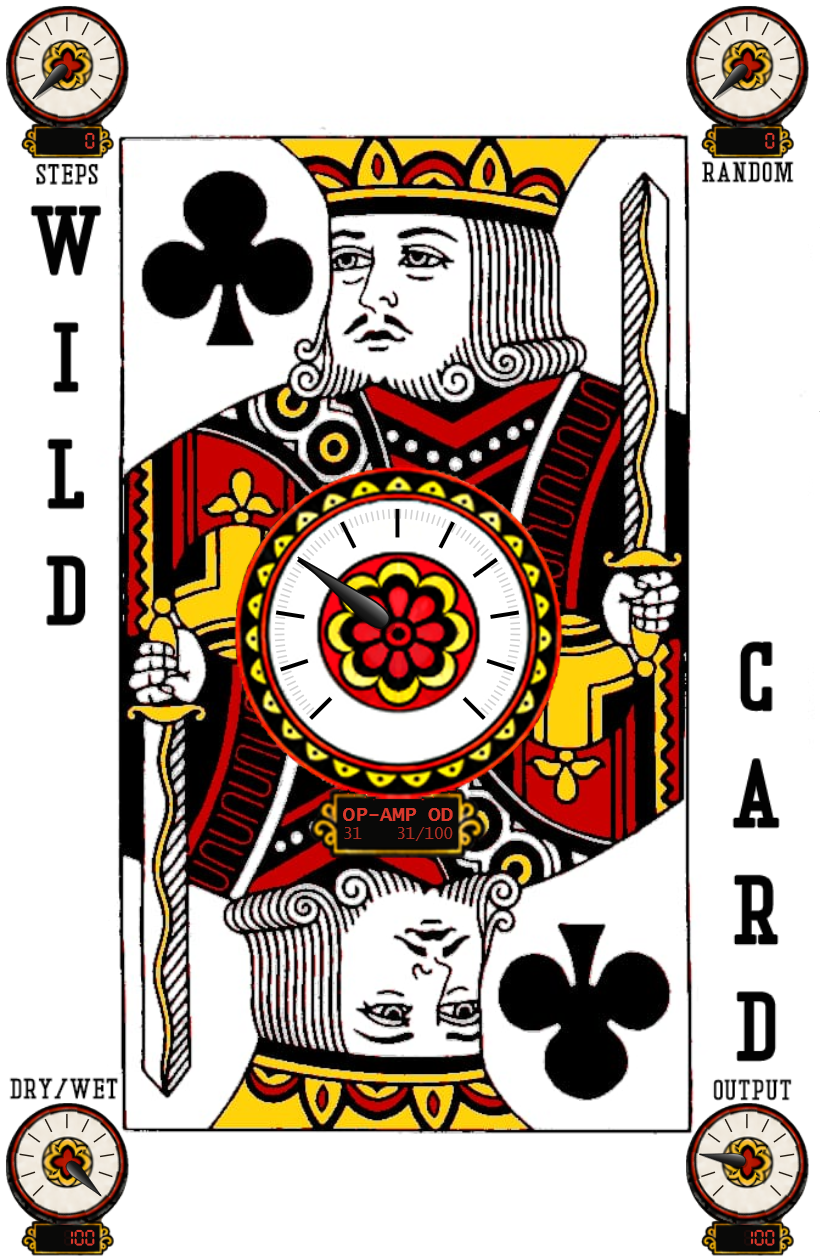
Wild Card is a distortion shaped like a playing card. There are a hundred distortion algorithms on the big knob in the middle, ordered so that no two neighbours sound alike, and one knob walks you through all of them.
What makes it one instrument rather than a hundred effects behind a menu is that there is only ever ONE processor running. An algorithm is not a piece of code here – it is 104 numbers and a transfer curve that describe a distortion.
Turning the knob between two of them interpolates every one of those numbers and the curve itself, and then runs the single processor from the result. At no point are two distorted signals crossfaded together. What moves is the SHAPE of the distortion, so the in-between positions are real distortions in their own right and not a mix of two others.
With STEPS at 0 the knob is a selector: one algorithm straight after the next, no transition, no smoothing. All one hundred play in a twentieth of a second if you automate the knob that fast. Wind STEPS up and blended positions appear between each neighbouring pair, up to 1090 of them.
HOW IT WORKS, IN PLAIN TERMS
1 CHOOSE The WILD CARD knob picks the algorithm, and the readout under it names it and tells you where you are: HARD CLIP, 1/100.
2 BLEND STEPS decides how many positions sit between one algorithm and the next. 0 gives the hundred alone; 10 gives 1090 positions and a continuous morph from one character into another.
3 SHUFFLE RANDOM reorders the hundred. 0 is the deliberate contrast order. 1 to 100 are fixed shuffles, and the same seed always gives the same route – in this session, in this project, and on any other machine.
4 BLEND IN DRY/WET against the original.
5 DRIVE OUT OUTPUT runs 0 to 500 percent and nothing catches it on the way out. Past a point it clips, which is the idea.
Price: free