Nereida — Microtonal Vocal Processor
Mainstream pitch correction hard-codes 12-TET at the code level: a MIDI note is treated as a fixed pitch, octaves are assumed equivalent, “in tune” means “on a piano key.” Outside that grid, these tools don’t just do a mediocre job — they erase the microtonal content that makes the performance what it is.
Nereida has no such ceiling. Internally it never assumes 12-TET, octave equivalence, or that a note is fixed — it runs on raw frequencies, cents, and ratios, so a 5-note scale, 17-EDO, 53-EDO, or a 400-note historical temperament gets tracked exactly as precisely as standard tuning.
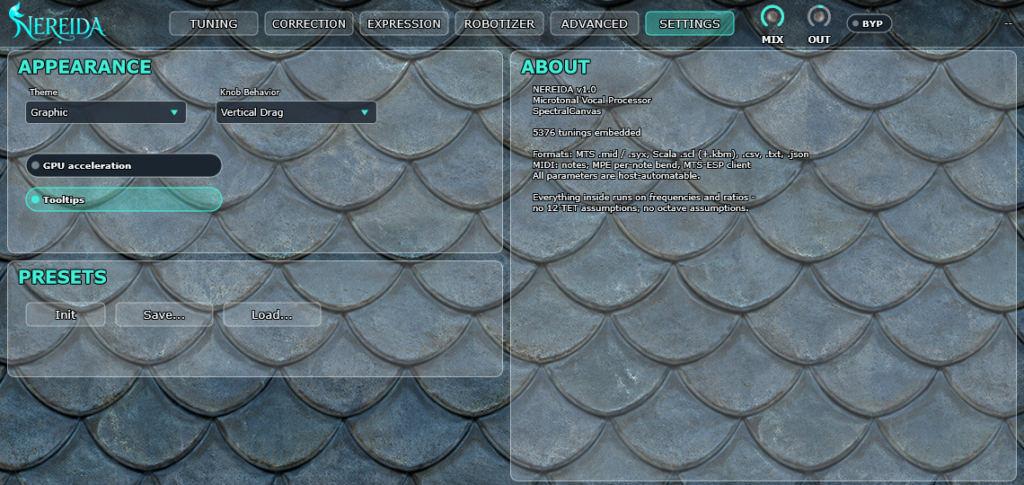
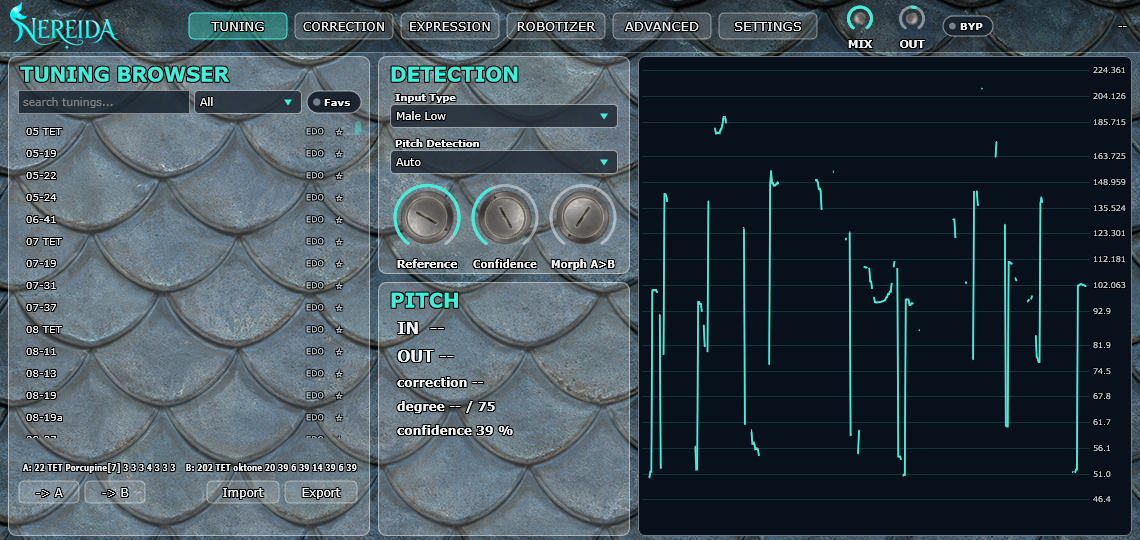
It ships with 5,376 tunings built in — no download, no hunting for a Scala file that may or may not load. Search “Hijaz,” “31-EDO,” or “Slendro” in the live Tuning Browser and it’s ready: EDOs, Just Intonation, historical and meantone temperaments, Arabic maqamat, Turkish makam, Persian dastgah, Indian raga/shruti, Indonesian gamelan scales, Partch, stretched and non-octave tunings. Favorite what you use, or import/export your own via Scala (.scl/.kbm), MTS, CSV, or JSON.
Load a vocal, hit record, sing. A hybrid YIN/pYIN/MPM detection engine — with source presets for voice, bass, strings, and whatever else is on the mic — tracks pitch and snaps it to the active tuning in real time, while a scrolling contour view plots against the tuning’s own lattice with live Hz/cents/degree readout, so you see exactly which microtonal step a note is homing in on. Load a second tuning and ride the Morph knob to glide from 12-TET into 31-EDO mid-phrase, or from Rast into Hijaz across a bridge — a texture no bolt-on autotune can touch.
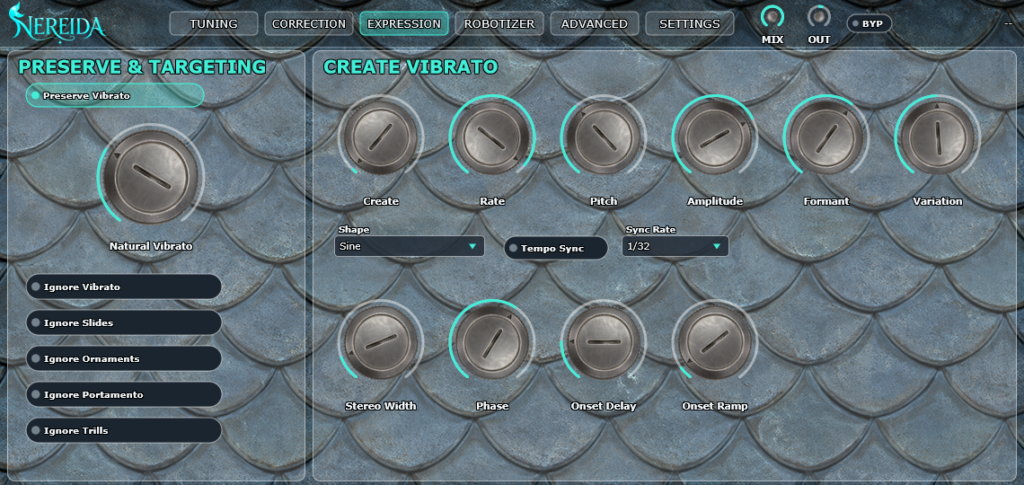
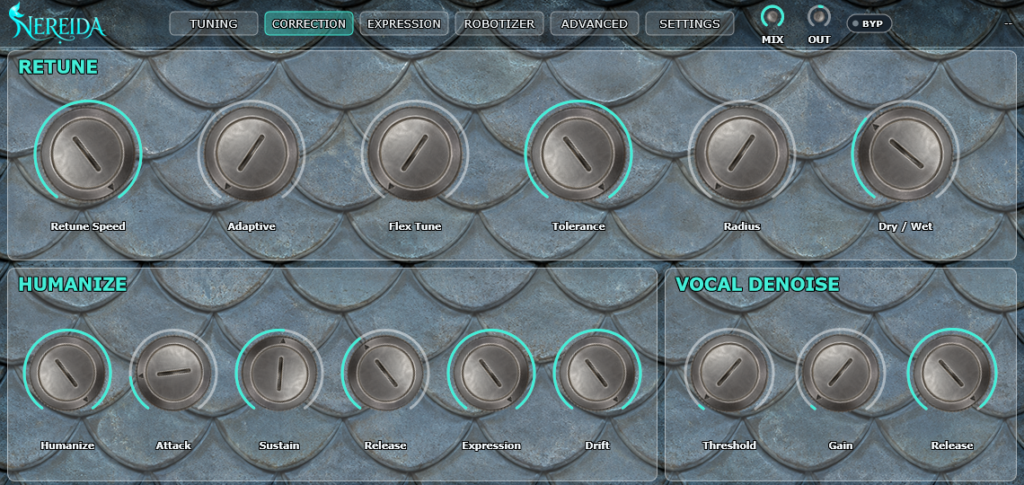
Correction shapes the performance instead of flattening it. Retune speed runs 0.01ms to 500ms, with Adaptive Retune easing big microtonal leaps so wide jumps don’t turn robotic. Flex Tune and the Tolerance Window are sized to the active tuning’s own step, not a hardcoded 12-TET assumption. Targeting can leave vibrato, slides, ornaments, and portamento alone — essential for maqam and raga phrasing a standard corrector would iron flat. Vibrato Preservation keeps what’s real; Create Vibrato (10 shapes, tempo sync, independent pitch/amp/formant/width depth) adds what isn’t. An independent formant engine reshapes gender, age, and throat size with zero pitch coupling.
Before any of that: Vocal Denoise. Voice-activity detection plus adaptive per-bin spectral gating strips hiss, hum, and room tone with soft-knee smoothing — none of the metallic, underwater artifacts cheap gates leave behind. Just three knobs: Threshold, Gain, Release.
Want something more destructive? The Robotizer tab is a physically modeled vocal-tract engine, not a vocoder skin: voice-box size, an excitation/compression stage, and a ring-mod/comb-resonator distortion stack that reacts to your actual pitch movement — working harder on fast runs.
Six clean tabs, 70+ automatable parameters in every major host, MPE/MIDI 2.0/MTS-ESP support, four MIDI targeting modes, OSC control, five latency modes for tracking through mixing.
Nereida: the first pitch-correction plugin that actually works for any tuning, not just twelve.