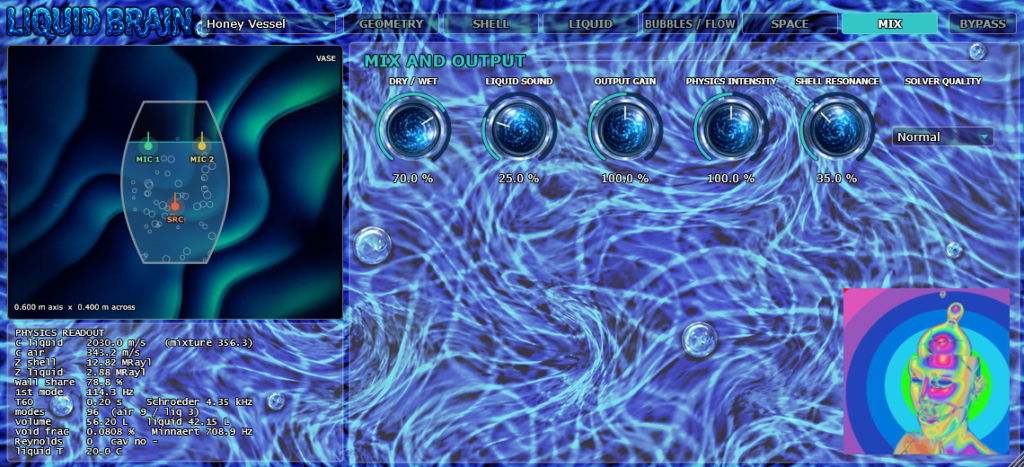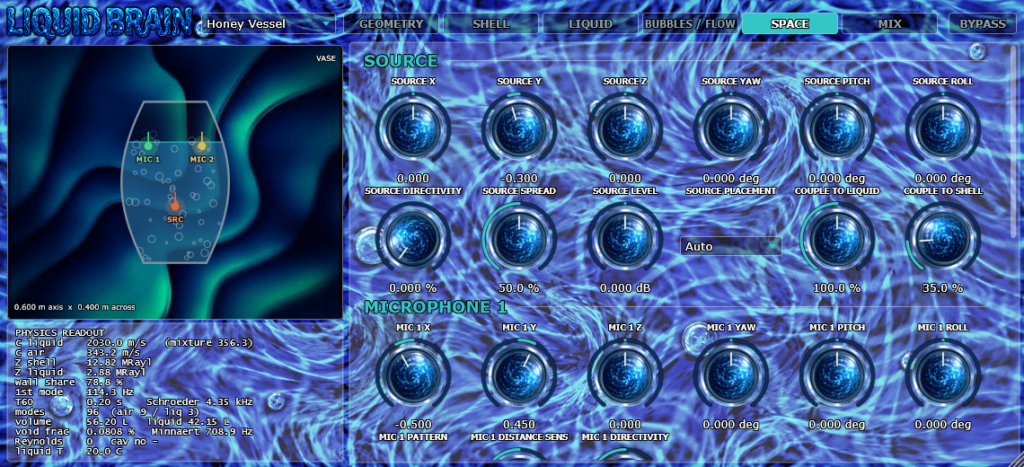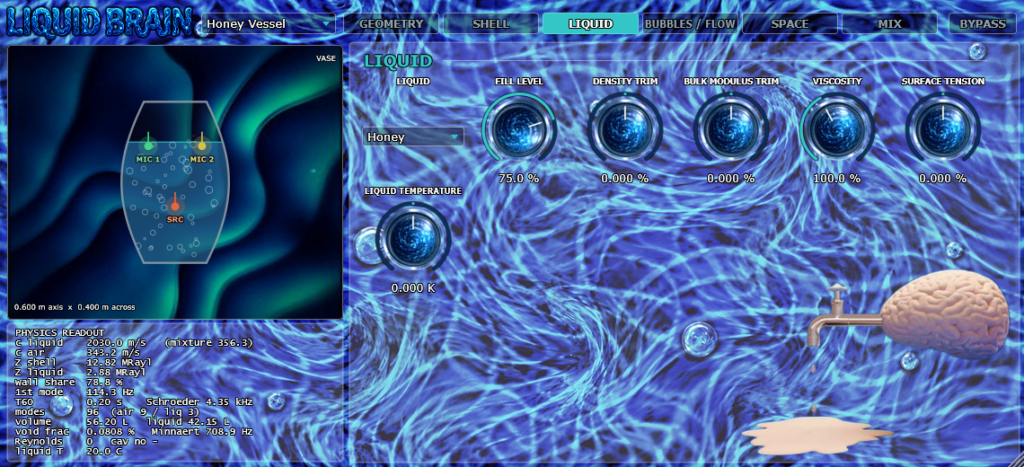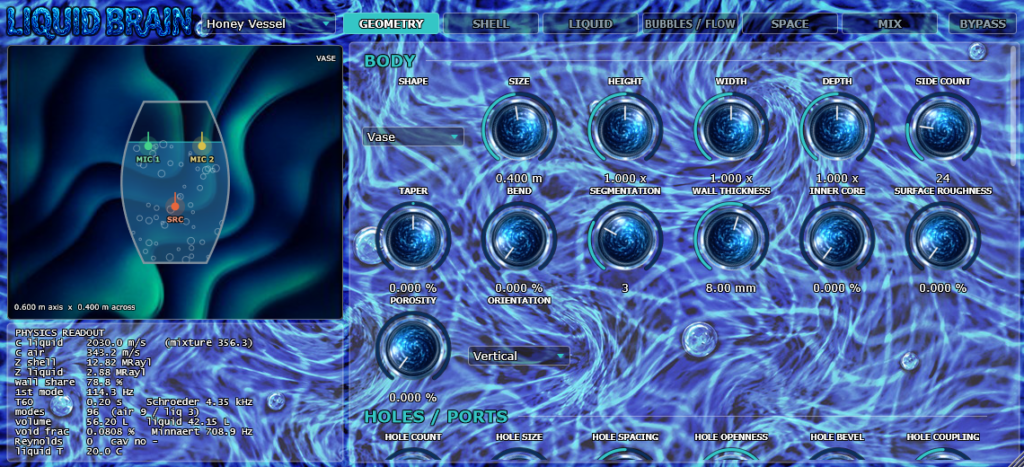
Put your sound inside a real object, fill it with something strange, and mic it.
What it is
Most “container” plugins are a reverb with a picture of a jar on it. Liquid Brain
actually builds the object and solves it.
You choose a shape, a material for its walls, and a liquid to pour
into it. You place your sound anywhere in 3D space — inside the air pocket,
under the surface, or outside the object altogether — and you place one or two
microphones anywhere else. Then the plugin works out what your sound would
really do in there: which resonances it wakes up, how the walls flex, how much
gets through, and what the liquid does about it.
Move the source two inches and the tone changes, because it lands on a different
part of the standing wave. That is not a modulation trick. It is what the maths
says happens.
Features
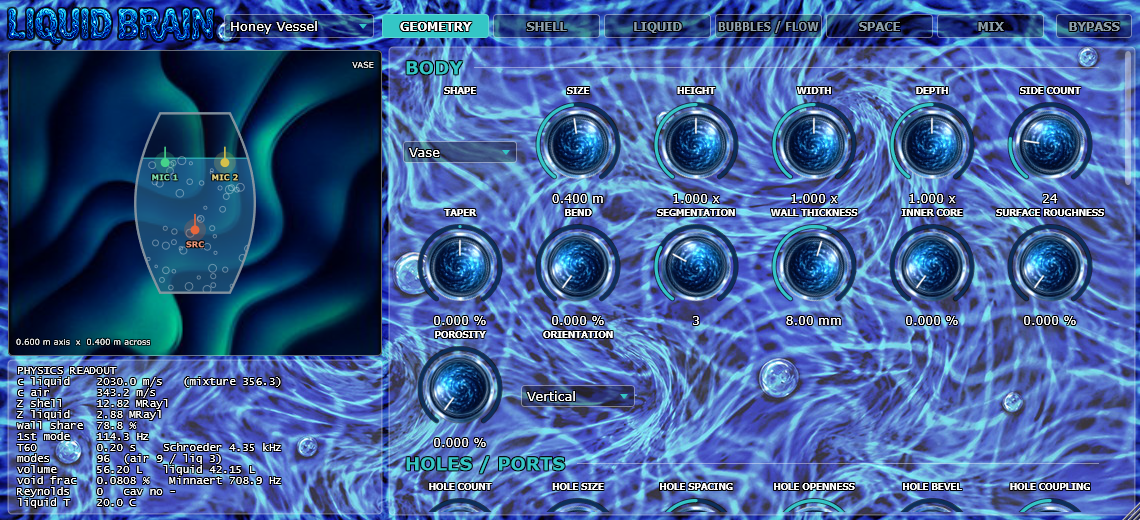
Bodies — 53 shapes
Cylinders, pipes, cones, spheres, bottles, flasks, horns, bowls, wine glasses,
barrels, hourglasses, bent and S- and U-bends, helixes, coils, labyrinths,
multi-chamber bodies, T- and Y-junctions, manifolds, perforated shells, a bong —
plus polygon bodies with 3 to 100 sides. Size, height, width, depth, taper,
bend, segmentation, wall thickness and an inner core are all yours.
Walls — 33 materials
9 metals, stone, concrete, three glasses, porcelain, ice, seven plastics,
silicone and rubbers, cork, and six woods with real grain direction — turn a
board sideways and it slows right down. Override density, stiffness, damping,
thickness, temperature, roughness, porosity and cracks.
Liquids — 19 of them
Water, seawater, ethanol, acetone, glycerol, castor and olive oil, silicone oil,
honey, mud, liquid nitrogen, liquid oxygen, mercury — and the exotic set:
brains, slime, goo and lava, which are deliberately weird and behave like it.
Plus a fully custom liquid.
Holes and ports
Automatic tonehole layouts, or switch to manual and right-click anywhere on
the object to drill your own — side walls, top, bottom. Drag them around. Each
one has its own size and openness, and each one retunes the body for real.
Vortex
Spin the liquid. It splits every circular resonance into a beating pair, drops
the pressure at the core until the bubbles detune and the whole thing cavitates,
and adds its own swirl. One of the most alive things in the plugin.
Flow and motion
Flow speed to 500 km/h, turbulence, cavitation, gas content, bubble count, size,
spread and rise, foam, sediment, sloshing, and non-Newtonian shear-thinning for
the thick ones.
Space
Full 3D placement and rotation of the source and both microphones, seven polar
patterns each, directivity, distance sensitivity, stereo width, crossfeed,
inter-mic delay. Drag them straight around the cutaway view.
Two engines in one
Smooth glides everything when you move — sweep a position and it doppler
slides. Glitch snaps instead: steppy, clicky, broken on purpose. Both are one
click apart.
Why you’ll want it
- It sounds like an object, not a preset. Because it is solving one.
- Every one of the 139 controls is automatable. Automate the fill level and
hear it fill. Automate the size and hear it grow. - A live readout shows the actual physics — sound speeds, impedances, first
resonance, decay time, bubble frequency — so you can learn what you’re doing. - Animated cutaway with the real shape, fill line, bubbles and your source
and mics, all draggable. - 20 presets that double as a tour: steel pipe, glass bottle, concrete tank,
oak barrel, mercury sphere, cryo flask, flooded labyrinth, cavitating pump,
brain jar, slime pit, lava tube, goo vortex. - Light on CPU
- Ships as VST3, CLAP and VST2 so it drops into whatever you already use.
Use it for
Drum rooms that don’t exist. Vocals sung into a flooded pipe. Bass that gets
thicker as the tank fills. Risers built by spinning a vortex up. Underwater
everything. Sound design for anything organic, wet, mechanical or alive. Or just
put a kick in a mercury sphere and see what happens.