Harmonic distortion where one band’s envelope drives another band’s grit
What it is
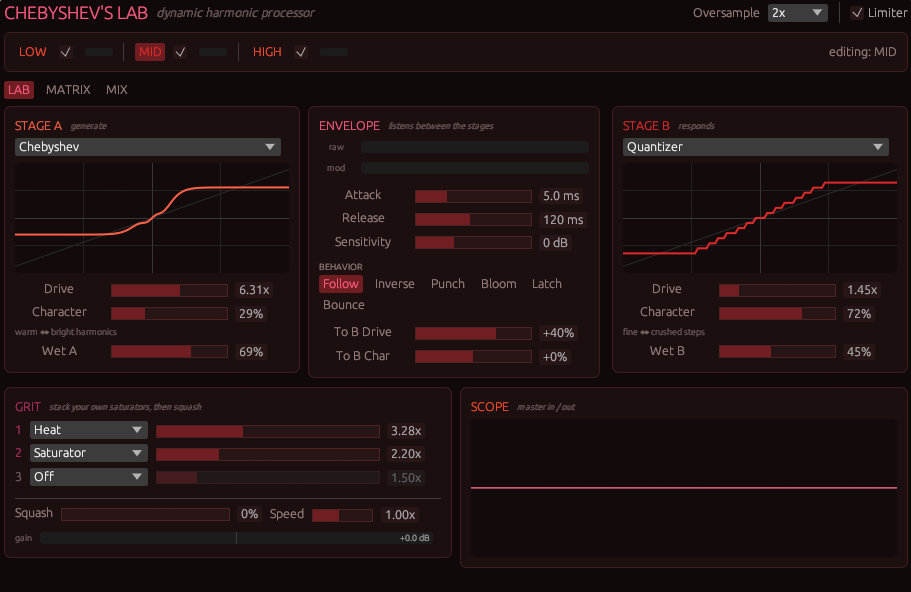
Chebyshev’s Lab is a dynamic, three-band harmonic processor. Each band runs
two serial distortion stages, and an envelope follower sits between them,
reading the signal after Stage A has already reshaped it and using that
reading to steer Stage B’s character. A global matrix then lets any band’s
envelope cross over and drive a completely different band.
How it works, in plain terms
Audio is split into Lo/Mid/Hi with a cascaded LR4 crossover. Inside each
band, Stage A shapes the waveform first; its output dynamics are measured
and fed forward to control Stage B, so the second distortion stage responds
to how hard the first one is already biting. A 6-slot modulation matrix
routes any band’s shaped envelope to any other band’s parameters or to
global width/output – bass transients can drive treble saturation, mids can
push low-end warmth. Disabled bands keep their smoothers and envelopes
running in the background so nothing “restarts cold” when you re-enable
them.
Features
PER-BAND (x3, Lo/Mid/Hi)
- Enable, Width, Drive A/B, Wet Mix
- Stage A/B character (tone), Envelope Attack/Release
- Per-band LFO: Rate, Shape, Amount
MODULATION MATRIX (6 slots)
- Source: Low / Mid / High envelope
- Target: 14 destinations across bands plus global width/output
- Amount, bipolar
GLOBAL
- Mix (Dry/Wet), Width, Output trim, Safety Limiter, Oversampling
- Crossover Lo/Hi split points
- Waveform preview scope, interactive spline editor, per-band envelope
displays, modulation matrix editor
Format: VST3, CLAP | Category: Distortion, Multiband